Cookie-Einstellungen


新闻
Endoscopy News: issue 02/2026 is ready! 2026-02-21


Endoscopy

Issue 02 · Volume 58 · February 2026

Submit Your E-Videos

E-VideosEndoscopy的开放获取在线专栏,专注于报道胃肠内镜领域具有研究价值的病例和新技术。所有文章均附有高质量视频,并采用知识共享署名许可协议(CC-BY)进行出版。

了解更多信息:https://endoscopy.thieme.com/e-videos 


Endoscopy 2026年第2期现已上线。欢迎免费阅读本期主编精选的三篇论文。

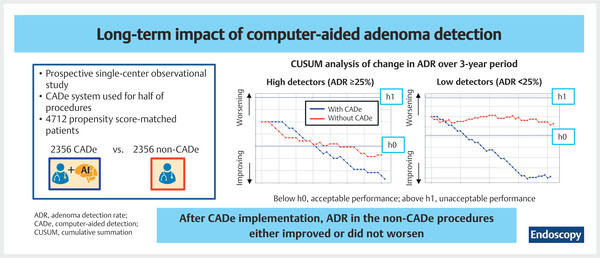
计算机辅助检测(CADe)对内镜医师结肠镜操作的长期影响是什么?腺瘤检出率(ADR)的提高是否可能伴随着技能退化(deskilling)?本期第一篇精选论文指出,对于“技能退化”的担忧并无必要。在为期3年的研究中,Okumura 等人记录了53名内镜医师在4712例结肠镜检查中的ADR变化(其中2356例使用CADe,2356例未使用CADe)。在使用CADe的操作中,无论是高检出率医师还是低检出率医师,其ADR均持续保持在较高水平。而在未使用CADe的操作中,高检出率医师的ADR实际上仍在持续提升,而低检出率医师则无显著变化。在引入CADe之后,即便在未使用CADe的操作中,所有内镜医师的检出率至少得以维持。

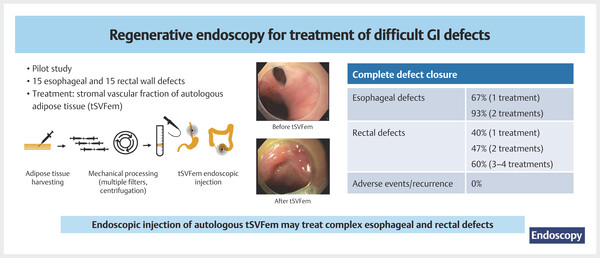
本期第二篇精选论文介绍了一个可能改变游戏规则的概念 — 再生性胃肠内镜。Nachira 等人在一项初步研究中,将来源于患者自身脂肪组织的基质血管组分(tSVFem)通过内镜注射至15例食管和15例直肠难治性缺损的边缘部位。对于较大的缺损(≥5mm),此前已进行内镜缝合。研究未出现并发症,并在30例患者中的23例实现了这些通常难以治疗病变的完全闭合。

尽管人工智能(AI)预计将对内镜领域产生深远影响,但目前关于其使用培训的指导仍然有限。作为本期第三篇精选论文,ESGE人工智能课程(ESGE AI Curriculum)首次为人工智能在内镜中的安全、高效整合提供了结构化路径。该立场声明通过专家德尔菲共识制定,明确了关键培训标准 — 从人工智能基础知识到人机偏倚管理 — 为帮助内镜医师充分实现AI驱动创新的益处树立了新的标杆。

欢迎阅读本期三篇精选论文及其它全部论文。

Original Article

Long-term impact of computer-aided adenoma detection: a prospective observational study

Taishi Okumura et al.

Background:Computer-aided detection (CADe) systems have improved the adenoma detection rate (ADR); however, concerns about its long-term effect on endoscopists’ performance without CADe and potential deskilling remain unaddressed. This study evaluated the impact of CADe on the learning curve of endoscopists for adenoma detection.

Long-term impact.jpg

Innovations and brief communications

Regenerative endoscopy for the treatment of difficult gastrointestinal defects: results from a pilot trial

Dania Nachira et al.

Background: Gastrointestinal (GI) defects with inflamed, fibrotic edges are often refractory to traditional endoscopic treatments. This study evaluates the efficacy and safety of endoscopically delivered stromal vascular fraction from autologous adipose tissue (tSVFem), which promotes tissue regeneration in upper and lower GI defects without additional patient risk or cost.

Regenerative endoscopy.jpg

Position Statement

Curriculum for safe and effective use of artificial intelligence in endoscopy: European Society of Gastrointestinal Endoscopy (ESGE) Position Statement

Yuichi Mori et al.

The European Society of Gastrointestinal Endoscopy (ESGE) has identified a critical need to establish structured training for safe and effective use of artificial intelligence (AI) in endoscopy. This manuscript presents the results of a formal Delphi consensus process and outlines the official ESGE position, offering a comprehensive curriculum for acquiring and maintaining the competence needed to exploit the benefit of using AI tools in endoscopy. The proposed framework defines the prerequisites in the preadoption phase, core training components, and requirements to maintain optimal implementation. Key recommendations include: (1) ensuring basic competency in standard endoscopy procedures; (2) acquiring foundational knowledge of AI principles; (3) implementing educational programs to enhance AI literacy; (4) recognizing and mitigating cognitive biases in human–AI interaction; (5) avoiding over-reliance on AI in clinical decision-making; and (6) continuous monitoring of key performance indicators throughout AI system integration.

Curriculum for safe and effective.jpg

欧洲胃肠道内镜学会(ESGE)及其附属学会的官方期刊。

Endoscopy为关于胃肠道内窥镜检查的最新技术和国际发展的重要期刊。在国际编委会的专家指导下,本刊提供高质量的内容,以满足全球内窥镜医师、外科医生、临床医生和研究人员的需求。

Endoscopy每年出版12期,内容包括高质量的综述论文、原创论文、前瞻性研究、有价值的诊断和治疗进展调查、以及对最重要的国内和国际会议进行的深入报道。文章经常辅以在线视频内容。

在Endoscopy上出版的所有论文都经过严格的同行评审。基于在线投稿和快速处理,保证了电子版和印刷版的出版速度。